
|
Key Takeaways
|
|
AppNeta by Broadcom recently introduced monitoring policies that streamline monitoring setup and maintenance, significantly reducing the time needed to manage your monitoring.
AppNeta is now introducing a range of new network rules in monitoring policies. These rules extend monitoring policies and make it simple to select the networks that should be monitored. This update is designed to further simplify your ongoing operations, particularly in managing dynamic, diverse networks.
What is the challenge?
Over the years, we've seen our customers’ networks evolve into complex ecosystems. They've embraced technologies like network segmentation using VLANs, SD-WAN deployments with multiple underlays, and a mix of Wi-Fi and wired networks in home and office environments. Customers require modern solutions to monitor these networks to reduce the time and effort needed for management.
How is AppNeta addressing this problem?
AppNeta Monitoring Points are deployed at critical locations in the network. Network monitoring can then be set up using network rules provided by the monitoring policies. Network rules are often needed when multiple networks exist on Monitoring Points. Here are a few examples of how that might work:
- When using consistent VLAN addressing or interface connections across many remote sites, use VLAN or Interface rules instead of individual subnet selection. Most customers can manage a large monitoring setup with just 2 or 3 network rules.
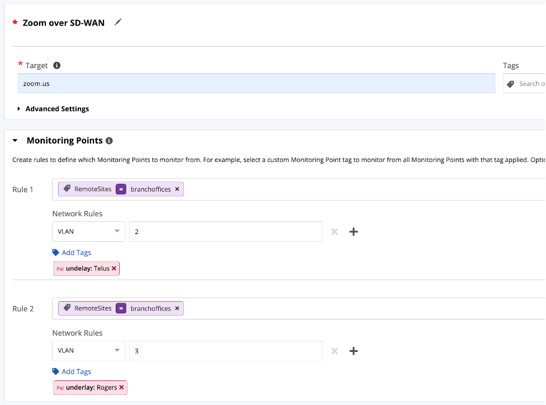
- You want to monitor the health of a network segment created with VLAN 2. A monitoring policy can be set up to monitor all Monitoring Points on VLAN 2 using a single network rule. This reduces the need to identify, set up, and manage monitoring one Monitoring Point at a time.
- You want to monitor multiple SD-WAN underlays that connect to different physical interfaces on the Monitoring Points. You can use the interface selection to monitor through the specific interface from a set of Monitoring Points.
- Do you want to monitor Wi-Fi or wired networks precisely? The connection: wireless/wired rule allows you to set it up with just one network rule.
Network rule tags
You can assign tags to the network rules to indicate the source network used to monitor. These custom tags allow you to search and filter the data for triage and dashboard purposes. For example, applying tags makes it easier to answer questions like:
- How is the corporate Wi-Fi performing today?
- How are my SD-WAN underlays performing?
- Which network paths are monitoring over VLAN 2?
… and more.
Related information
Use Monitoring Point Tags to select large sets of Monitoring Points. Monitoring Point tags can then be used in monitoring policies. This is especially important when your cabling/network rules apply only to a subset of your Monitoring Points.
Educational resources
- To learn more about configuring network monitoring, check out this online course: AppNeta: Create Monitoring Policies for Active Monitoring.
- For a quick look at how to create monitoring policies, check out this video tutorial: Create a Standalone Monitoring Policy in AppNeta.
Release information
- Watch the release notes for more information and links to in-depth technical documentation.
Coming soon
Monitoring Policies will soon support web application monitoring in addition to network monitoring. Web monitoring policies provide a simple, scalable, and automated way to set up monitoring for your web applications (Experience). If you would like to participate in early access to this feature, please contact your Broadcom account representative.

Vibhu Dubey
Vibhu Dubey serves as a Product Manager at AppNeta by Broadcom, boasting a remarkable career spanning more than 15 years in the domains of network monitoring and automation, with a distinct emphasis on user experience monitoring.
Other resources you might be interested in
Rally Office Hours: October 8, 2026
Find out about a new “my notifications” widget and an enhanced planned/unplanned widget. Hear about diverging axis views and upcoming cycle time widgets.

Going Off-Road: How We Bulletproofed Automic's Zero Downtime Upgrades
To ensure absolute reliability at SaaS scale, Automic Automation recently evolved its ZDU strategy.
Rally Office Hours: October 1, 2026
Explore Rally updates, including end-to-end markdown support, a new defect trend widget, an update dependency widget, and custom view migration status.

Clarity: Design Visual Layouts Using Report Designer
This course teaches you how to create new reports with the Clarity Report Designer.
Rally Office Hours: September 24, 2026
Find out about a new milestone cumulative flow diagram widget and custom view widget capacity. Get tips for handling project name changes in middleware.
Rally Office Hours: September 17, 2026
Explore Rally's new delivery confidence feature for portfolio items, hear custom view migration updates, and get expert answers to Q&A.
Rally Office Hours: September 10, 2026
On the latest Rally Office Hours, learn more about new burn-down widgets, custom page migration updates, technical Q&A, and Broadcom community events.
Rally Office Hours: September 3, 2026
Review the latest Rally Office Hours summary covering the MCP Server upgrade, custom page migration updates, API tooling, Q&A, and upcoming event news.
AAI v26.0 Container Deployment
This foundational training course focuses on modernizing enterprise workload analytics across OpenShift and Kubernetes environments.