
June 25, 2026

Learn how the Summer 2026 updates make your daily network operations quieter, smarter, and easier to manage.
6 min read
|
Summary
|
|
In the summer of 2026, Network Observability by Broadcom will receive an array of updates that will help teams reduce operational overhead and alert fatigue. Featuring agentic AI and a modernized, cloud-native architecture, this release will empower network engineers to automate compliance and save valuable maintenance time. Key Takeaways
|
As a network engineer, you likely face two persistent operational challenges every day:
-
Managing high volumes of network alerts, many of which require no action.
-
Spending valuable time on the maintenance of your infrastructure and monitoring systems.
When you have to manually track device lifecycles on spreadsheets or spend your scheduled maintenance periods troubleshooting software upgrades, you lose the time you need to proactively ensure network performance.
Over the past six months, we have continued to enhance Network Observability by Broadcom. These latest enhancements directly address the operational challenges outlined above. We have focused on making network operations quieter, smarter, and easier to manage. By introducing AI for compliance, intelligent noise reduction for incident response, and a cloud-native platform architecture, the solution helps you work faster and with more confidence.
Reducing alert fatigue with intelligent alarms
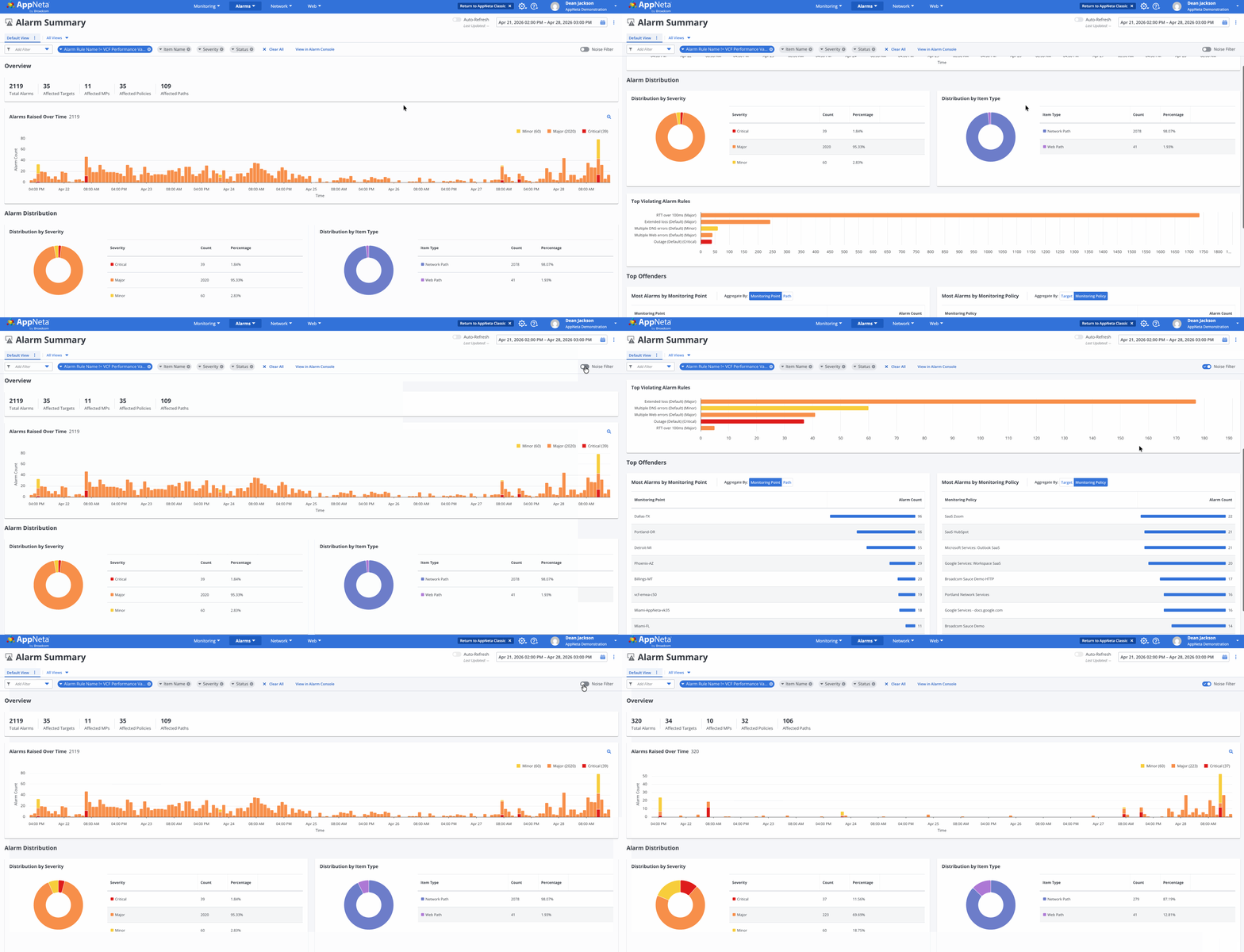
When your monitoring systems generate alerts for every minor, transient network stutter, you can easily experience alert fatigue. This often leads to critical issues being missed because they are buried among hundreds of non-actionable notifications. To solve this, we have introduced intelligent alarms in AppNeta.
With this feature, the solution evaluates your network metrics on a precise, minute-by-minute basis. The solution then pairs this granular visibility with smart, persistence-based filters. Instead of triggering an alert the moment a drop occurs, the engine automatically tracks the duration and frequency of an anomaly. It identifies isolated, brief spikes and filters them out, so you only get an alert when it truly needs your attention. By suppressing this unnecessary chatter, the solution helps you focus your attention on resolving the verified problems that actually degrade the experience of your end users.
To complement this capability, we have introduced precision network events and continuous diagnostics. You can now calculate exact maximum data transmission rates across your links. This continuous, granular visibility allows you to confidently and immediately pinpoint packet loss, bandwidth bottlenecks, and changes in quality of service or maximum transmission unit (MTU) metrics. These capabilities help ensure your teams always have an accurate understanding of network capacity.
Expanding visibility across hybrid networks
Ensuring consistent visibility across externally managed public cloud environments can often require specialized cloud expertise. Our new Cloud Monitoring Points simplify this process. You can now deploy lightweight, self-upgrading containers directly on AWS, Azure, and Google Cloud. This gives you instant, bi-directional network visibility into your virtual private clouds, without requiring hardware or container orchestration.
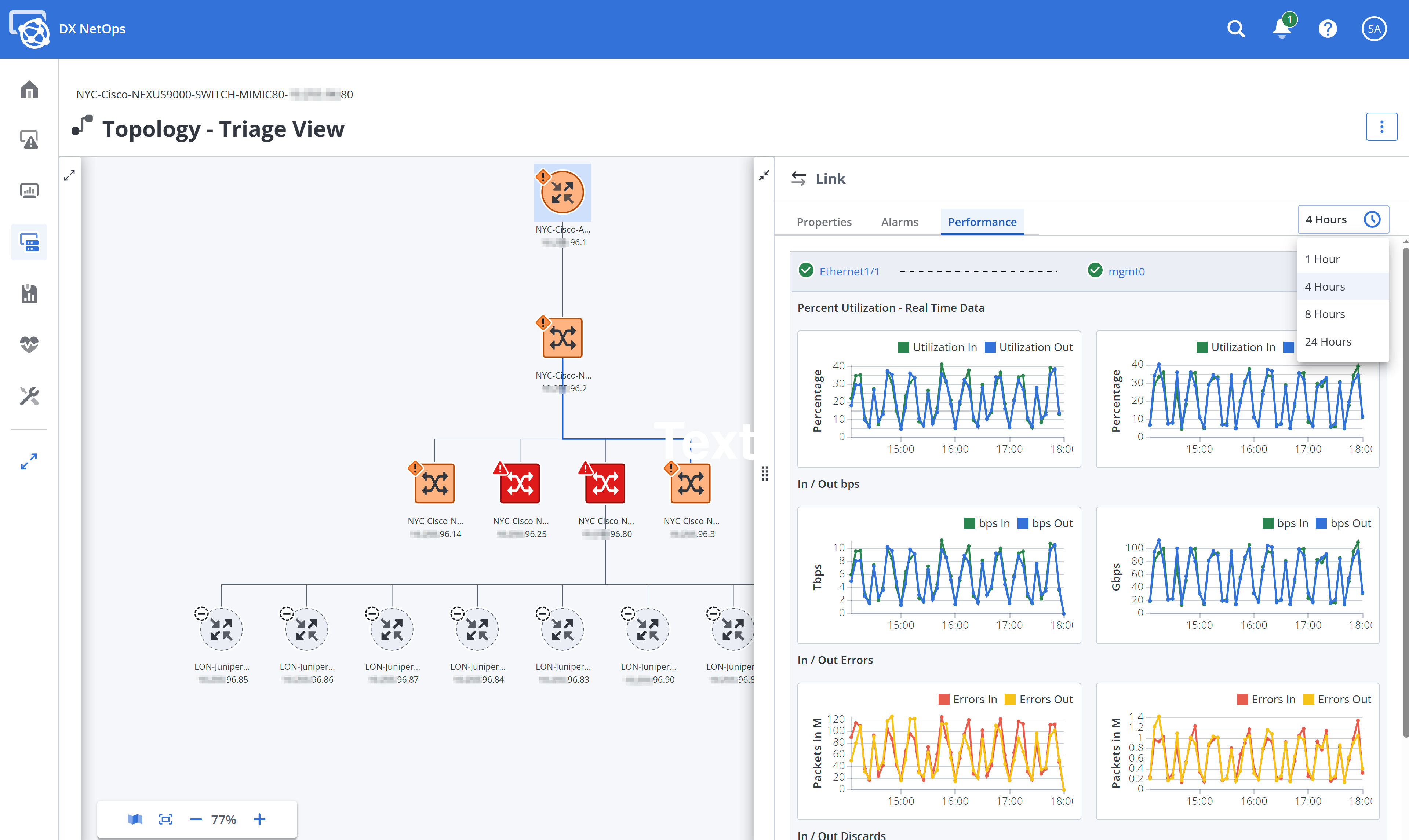
Additionally, our topology enhancements help you navigate large-scale networks. Advanced device clustering automatically organizes devices into logical groups based on connections and IP clusters, which reduces the visual complexity of your network maps. When a failure occurs, multi-hop triage lets you visualize the exact upstream and downstream effects, helping you identify the root cause of an outage much faster.
Automating compliance with agentic AI
Keeping track of hardware lifecycles, security vulnerabilities, and device configuration compliance has always been a manual and slow process. By introducing agentic AI, we are transforming how you handle network governance.
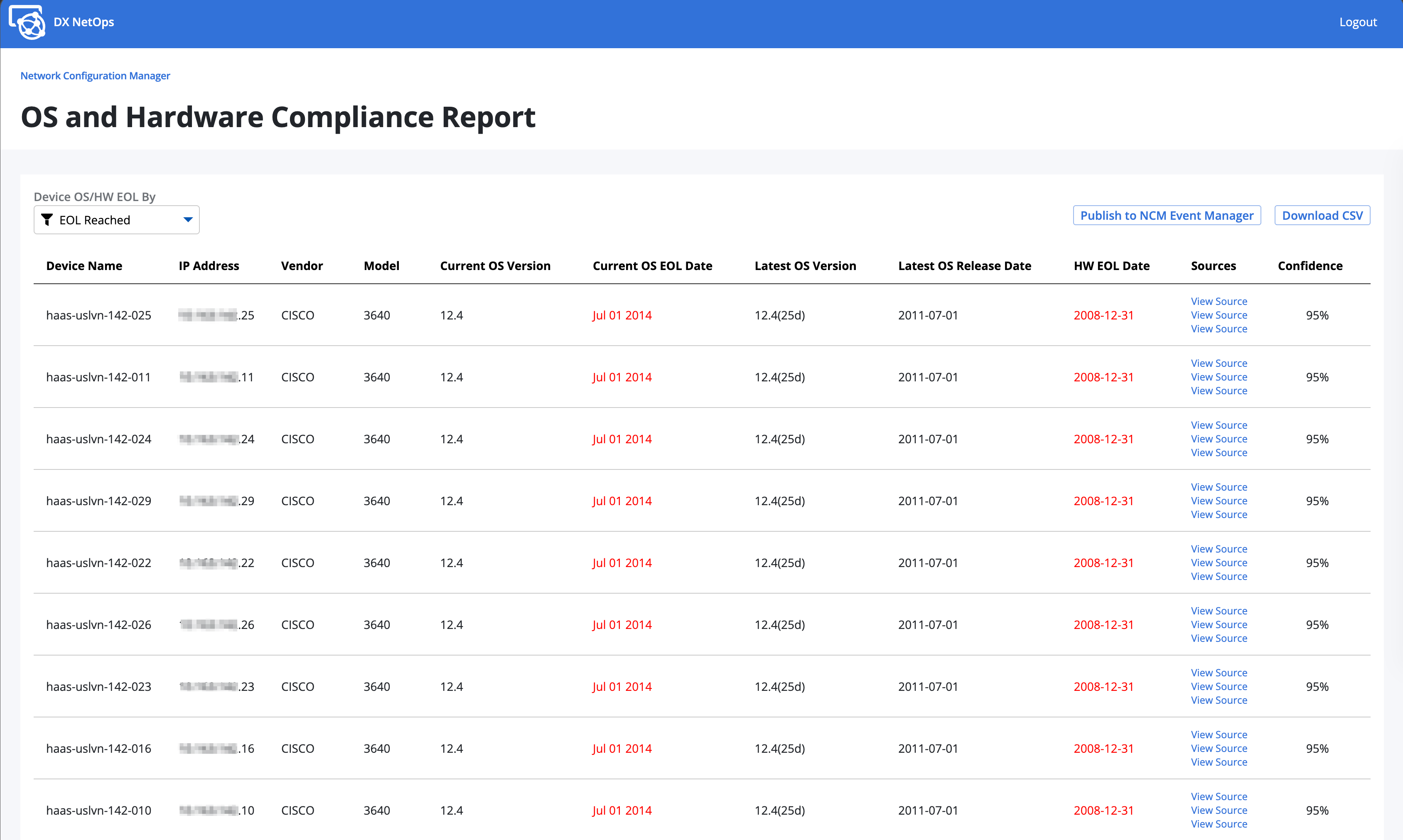
To make this work without exposing your private data, we built a continuous-loop workflow that operates on Broadcom’s cloud infrastructure. Our cloud-based AI agents constantly monitor the internet, crawling hardware vendor sites to extract unstructured data from PDF tables, footnotes, and vulnerability databases. The system then normalizes this raw data into structured end-of-life dates and CVE profiles.
These compiled vendor intelligence packages are included with every new product release, and delivered securely to your on-premises network configuration management (NCM) engine. Your local engine then conducts compliance scans against your inventory. Your private network topologies, IP addresses, and device configurations never leave your secure internal network. This dual-architecture design ensures you can automate vulnerability tracking and plan hardware refreshes, while maintaining strict data privacy.
Plus, our new Device Certification Portal serves as a searchable registry covering over 9,100 devices from more than 450 hardware vendors. You can instantly search the portal to verify out-of-the-box telemetry support. With these capabilities, you can bring new devices online with the assurance they are fully supported.
Simplifying your observability platform
A network monitoring tool should not be as difficult to maintain as the network itself. To reduce your administrative overhead, we are modernizing the underlying architecture of DX NetOps and AppNeta.
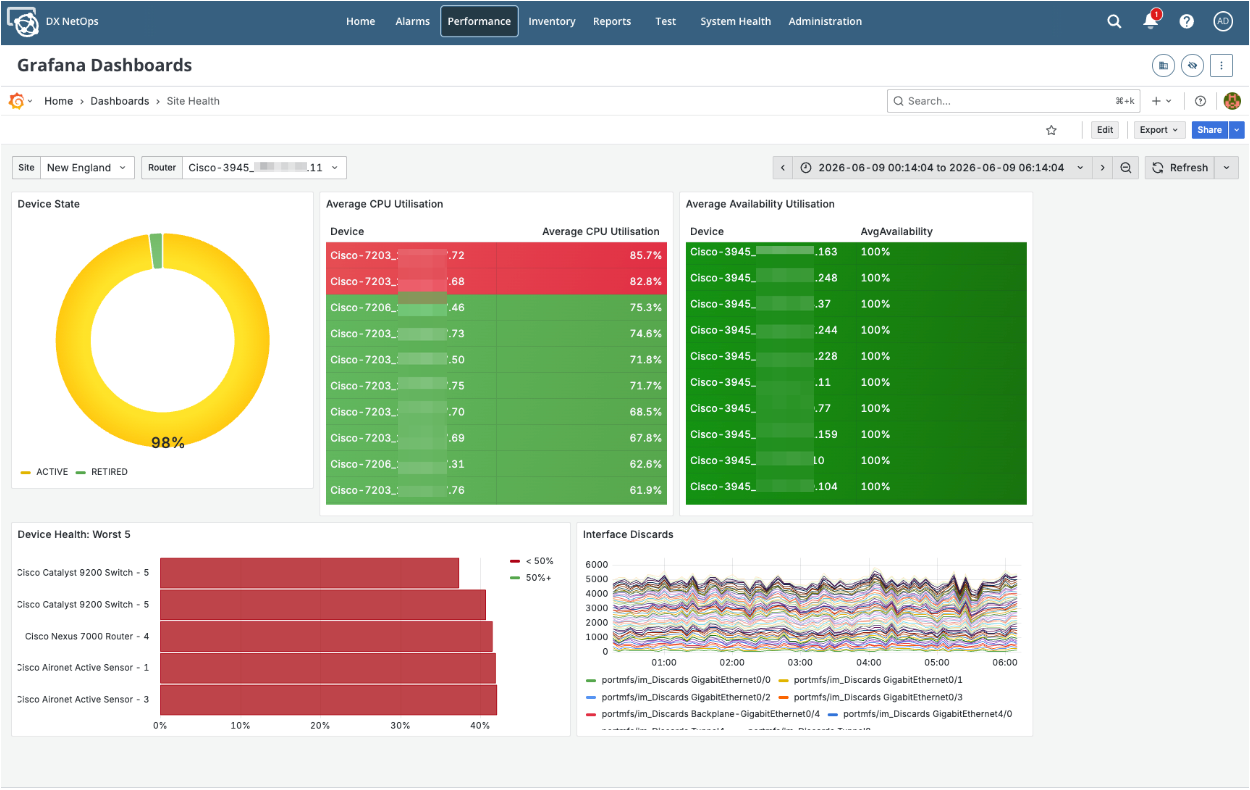
For operators who frequently switch between operational domains, such as infrastructure health, flow data, and user experience metrics, we have introduced a new generation of customizable dashboards. With these dashboards, you can build high-density, multi-variable views that unify multiple data sources on a single screen, eliminating the need to switch between multiple types of reports. If your organization relies on external business intelligence tools, our support for the new OData 4 API standard allows you to securely share network metrics with external systems, while reducing client-side processing overhead.
We also simplified how you scale and maintain the platform. Our new distributed flow collection architecture allows you to aggregate flow data at regional data centers, minimizing the cost of sending large volumes of raw traffic data over your wide area network.
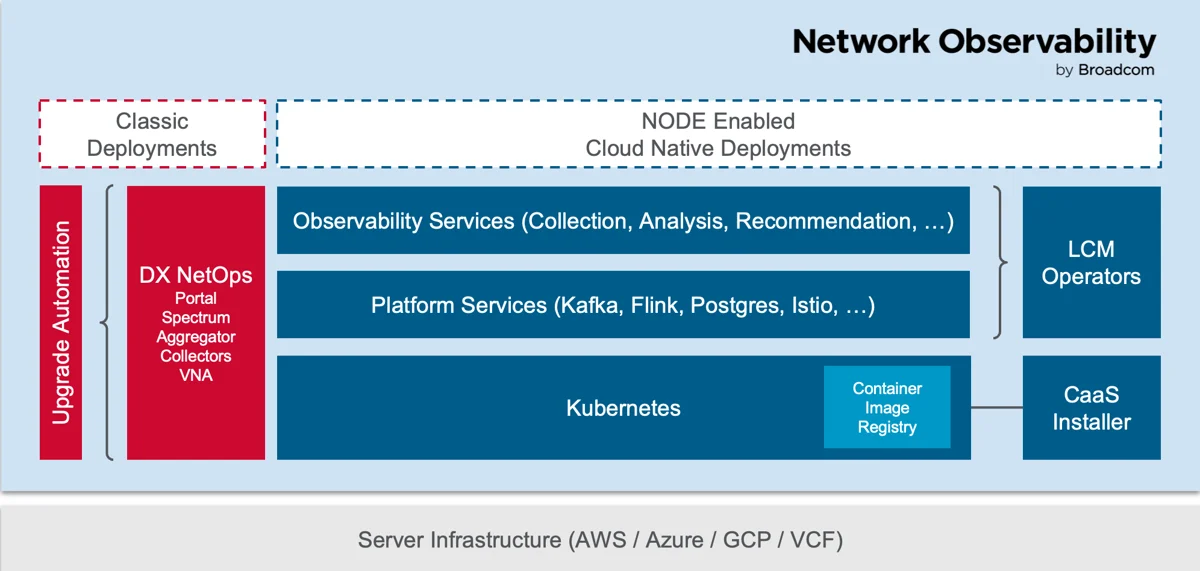
To shorten your scheduled maintenance periods, our Upgrade Automation Tool uses repeatable, Ansible-based playbooks to handle pre-flight checks and let you resume interrupted upgrade tasks exactly where they left off. Apart from these upgrade workflows, we transitioned to a Kubernetes-based foundation that provides environment abstraction and a shared service layer. This cloud-native architecture enables highly resilient, standardized deployments that minimize human errors and further reduce your day-to-day administrative overhead.
Reclaiming your time
Managing complex enterprise networks does not have to mean accepting constant alert fatigue or spending your weekends maintaining monitoring platforms. With the Summer 2026 updates to Network Observability by Broadcom, we provide the capabilities you need to work more efficiently. By cutting out notification noise, automating device lifecycle compliance, and drastically simplifying platform administration, you regain the time needed to focus on making strategic network improvements and ensuring reliable service delivery.
Want to learn more? Watch our on-demand webcast, “What’s New in Network Observability for Summer 2026.”
Tag(s):
DX NetOps
,
AppNeta
,
Network Monitoring
,
Network Observability
,
Network Management
,
NCM
,
NetOps NCM
Sean Armstrong
Sean Armstrong is a seasoned product leader with over 22 years of experience in IT enterprise software. As Senior Director of Product Management - Network Observability, Sean brings a wealth of knowledge and expertise to the field. His career spans roles at leading companies like Network Intelligence, EMC, Apparent...
Other resources you might be interested in

What’s New in DX NetOps Topology: Summer 2026
See what’s new in DX NetOps topology. Leverage capabilities for expanded multi-vendor discovery, faster triage, custom views, and seamless data exports.
Controlling Flow Telemetry Overhead in Distributed Environments
See how the latest updates to NetOps Flow reduce telemetry overhead and optimize WAN usage. Simplify data extraction and integration with the OData 4 API.
Chart Your Team’s Analytics Journey with Customizable Dashboards in DX NetOps
DX NetOps now features customizable dashboards, providing standards-based flexibility and an easy way for new and existing users to add custom dashboards.
What’s New in Network Observability for Summer 2026
Find out about the updates coming to Network Observability by Broadcom. See how you can reduce alert fatigue, automate compliance, and simplify management.
Automating Device and OS Compliance in Air-Gapped Networks with Agentic AI
Secure air-gapped networks by automating device compliance. Employ a hybrid agentic AI workflow that separates public intelligence from internal audits.
Migrating Your DX NetOps Integrations from OData 2 to OData 4
Moving DX NetOps to OData 4? Learn how to identify active API queries, update your endpoints, and adjust your query syntax for a seamless transition today.
Unifying Network Configuration Management and Observability
Learn how unifying Network Configuration Management with comprehensive observability eliminates operational blind spots.

DX NetOps: Unified Collection Framework Install
This course is designed to provide a clear, easy-to-follow guide for setting up and managing the Unified Collection Framework (UCF).
Debunking the Myth of the Homogeneous Network
Tame multi-vendor network chaos by harnessing a single, scalable observability platform that unifies fault, performance, and configuration data.