
February 11, 2026

Why we re-engineered the platform to match the complexity of the networks you manage.
5 min read
|
Key Takeaways
|
|
If you work in network operations, you know that the only constant is the increasing complexity of the infrastructure you manage. The days of installing a monolithic software package on a single bare-metal server and letting it hum along for years are largely behind you. The software industry has largely shifted toward cloud-native architectures, microservices, and containerization. While these shifts promise agility and scalability, they also introduce significant operational complexity.
You are likely seeing this transition firsthand. The tools you use to monitor the network are becoming distributed systems themselves. This evolution is a must for tools that have to handle the volume and velocity of modern network traffic. However, this shift places a heavy burden on both the software vendor and the network engineer. This compels us to have a conversation about how we build, deliver, and maintain the critical foundations that power your digital business.
The software architecture shift
The state of the art in software architecture has moved decisively toward Kubernetes and microservices. The logic is sound: Break a massive application into smaller, more manageable pieces that can scale independently. If your flow collector needs more power, you scale that specific service, not the entire management suite.
However, orchestrating these moving parts requires a level of infrastructure maturity that many organizations are still building. For a software vendor like us, this creates a significant challenge. You cannot simply ship a container and hope for the best. You have to ensure that the orchestration layer is rock solid. You must guarantee that the application behaves identically whether it is running in a public cloud, a private data center, or an air-gapped secure environment. Without a modern approach, the vendor spends more time debugging installation scripts for different Linux distributions than building the features you actually need to analyze network performance.
Introducing NODE
The solution to this complexity lies in proper abstraction. You need a layer that sits between the raw infrastructure and the application logic. This is the driving force behind NODE (Network Observability Deployment Engine) from Broadcom.
In the past, every application team might have spun up their own database, their own messaging queue, and their own security protocols. This leads to tool sprawl and fragility. If every tool manages its own plumbing, you end up with a dozen different ways to patch a security vulnerability.
NODE represents a modern approach based on environment abstraction and a shared service layer. Instead of reinventing the wheel for every product, the platform provides standardized services. Things like identity and access management, messaging, databases, and secrets management become shared utilities. The application simply consumes them. This standardization is critical. It means that when you deploy the software, you aren't just dumping binaries onto a disk; you are deploying a managed ecosystem that handles the "boring" stuff so the application can focus strictly on its core business logic.
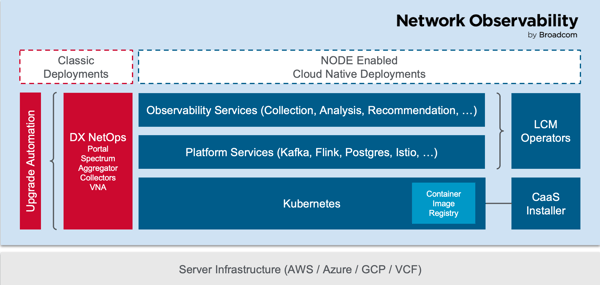
Network observability hybrid deployment model
Ending the upgrade nightmare
Beyond just running the software, you have to manage its lifecycle. Let’s be honest, upgrading a distributed system manually is often a nightmare. Managing the underlying Kubernetes cluster lifecycle, from initial deployment to subsequent version upgrades, is a massive operational challenge. It usually involves a high degree of risk and requires specific expertise that network teams shouldn't necessarily have to maintain.
This is where the NODE approach changes the dynamic. The platform is engineered to abstract this complexity entirely. Broadcom utilizes the Kubernetes Operator pattern to handle lifecycle management. Instead of relying on brittle scripts, the platform utilizes this architectural standard to automate complex “day-2” operations.
This approach not only streamlines the initial deployment process but also guarantees application compatibility. The platform handles the Kubernetes upgrades and maintenance that might otherwise introduce significant risk. It ensures that a platform-level update does not unexpectedly disrupt the network observability applications. This removes the anxiety from upgrades and reduces the risk of human error during maintenance windows.
Why this matters
You might wonder why a vendor’s internal architecture should matter to you. It matters because it dictates the velocity of innovation. By decoupling the underlying infrastructure from the applications running on top of it, engineering teams can move faster. They stop fighting with the nuances of different storage backends or networking configurations and start focusing entirely on delivering unique business value, such as better anomaly detection or faster root cause analysis. It eliminates the "works on my machine" problem and ensures that quality assurance happens on a platform that is identical to the one running in production.
Real benefits for the network engineer
For you, the end-user, the benefits are tangible. The most immediate impact is stability and reliability. A standardized, pre-engineered platform means that the components have been tested together exhaustively. You get a production-grade Kubernetes foundation without necessarily having to be a Kubernetes expert yourself.
Furthermore, this approach offers immense flexibility. The new platform allows for different deployment models. If you want a "batteries included" experience, you can utilize a platform-managed model. With this model, the installer handles the Kubernetes layer, the container image registry, and the security configurations. However, if your organization has already invested heavily in its own Kubernetes infrastructure, you can choose a customer-provided model. You deploy the observability stack onto your existing clusters, leveraging your own standards, while still benefiting from the platform's shared services and lifecycle automation.
The path forward
We are improving Network Observability by Broadcom head-on by creating a unified platform designed to be the foundation for all our cloud-native applications. The goal is to provide a seamless experience, whether you are running in a public cloud, a virtualized private cloud, or a high-security, air-gapped facility. By integrating a robust CaaS (container as a service) layer, standardized application packaging, and a suite of shared services, the platform makes the complex underlying technology invisible to you, leaving you to work with a powerful, resilient toolset for network operations.
The focus is ultimately on reducing the friction between you and the data you need. By modernizing the delivery mechanism, the software becomes easier to install, easier to upgrade, and easier to trust.
For a deeper look into how we are streamlining network management through this platform approach, visit our Network Observability by Broadcom page.
Idan Green
Idan Green is a technology product manager specializing in cloud technologies, automation, and orchestration. With over two decades of experience evolving alongside the telecommunications industry, Idan brings deep technical roots to his role at Broadcom, where he drives network observability platform solutions for...
Other resources you might be interested in
Automic Automation: Transition to SAP RISE with Confidence
Automic Automation safeguards Clean Core architecture, mitigates SAP RISE migration risks, and unifies enterprise scheduling from mainframe to cloud.
AutoSys Workload Automation: Transition to SAP RISE with Confidence
AutoSys safeguards Clean Core architecture, mitigates SAP RISE migration risks, and unifies enterprise workload scheduling from mainframe to cloud systems.

AppNeta: Manage Alarm Rules
Learn how to create and manage alarm rules in AppNeta. Detect, isolate, and present user-impacting issues to network operations center teams.
Rally Office Hours: October 8, 2026
Find out about a new “my notifications” widget and an enhanced planned/unplanned widget. Hear about diverging axis views and upcoming cycle time widgets.

Going Off-Road: How We Bulletproofed Automic's Zero Downtime Upgrades
To ensure absolute reliability at SaaS scale, Automic Automation recently evolved its ZDU strategy.
Rally Office Hours: October 1, 2026
Explore Rally updates, including end-to-end markdown support, a new defect trend widget, an update dependency widget, and custom view migration status.
Clarity: Design Visual Layouts Using Report Designer
This course teaches you how to create new reports with the Clarity Report Designer.
Rally Office Hours: September 24, 2026
Find out about a new milestone cumulative flow diagram widget and custom view widget capacity. Get tips for handling project name changes in middleware.
Rally Office Hours: September 17, 2026
Explore Rally's new delivery confidence feature for portfolio items, hear custom view migration updates, and get expert answers to Q&A.