
March 26, 2026

How to tame the chaos of your multi-vendor ecosystem and move from reactive troubleshooting to proactive optimization.
5 min read
|
Key Takeaways
|
|
If you have been in network operations for more than a week, you know the dream of the single vendor shop is exactly that, just a dream. In the practical reality of your daily job, the network is a diverse, chaotic ecosystem. It is a complex stack in which layers of technology from different times and vendors coexist, often uneasily. You likely have the latest SD-WAN appliances handling the edge, legacy switches in the wiring closets of branch offices, and load balancers from another vendor in your private cloud.
Managing this complex ecosystem requires more than just keeping the lights on. It requires a new mindset in how you view network monitoring. The challenge isn't just about depth anymore, but breadth. You need to handle the entire landscape, regardless of whose logo is stamped on the casing.
Taming the network zoo
Consider the friction you experience when users report a slowdown. If you are operating with fragmented tools, you are likely switching between multiple consoles. You check the SD-WAN controller for the overlay performance. You check a separate SNMP tool for the underlay switch health. You might even log into a command line interface (CLI) to check if a configuration change was made last night. This context switching is not just annoying; it is the single biggest drain on your productivity and the main contributor to extended mean time to resolution (MTTR).
The reality is that your network is heterogeneous by nature and by necessity. Mergers and acquisitions bring in foreign infrastructure. Best-of-breed procurement strategies mean you buy the best firewall from one company and the best Wi-Fi from another. If your observability strategy relies on vendor-specific tools, you are introducing blind spots at the intersections of those networks. You need a monitoring platform that is agnostic to the underlying hardware, capable of ingesting data from any source—including SNMP, APIs, flows, and streaming telemetry—and normalizing it into a coherent narrative.
Trinity of context
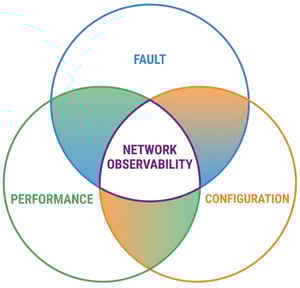 Successful network observability comes from the intersection of three specific data planes: fault, performance, and configuration. Many tools excel at one but fail at the others. A tool might be excellent at telling you a device is up but terrible at telling you why jitter is high. Even fewer tools can correlate those metrics with the fact that someone pushed a bad access control list (ACL) update at 3:00 a.m.
This intersection is where modern observability platforms must focus. For example, in Broadcom’s approach to network observability, the focus is on integrating these distinct data sets from across multi-vendor landscapes. We help you correlate a spike in interface errors on a router with a configuration change on a firewall, all while monitoring the flows traversing the WAN edge. By unifying fault, performance, and configuration management, you can move from reactive troubleshooting to proactive optimization.
Verification over blind faith
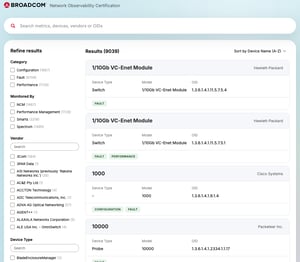 Talk is cheap, and vendor promises about supporting everything are common. However, for a network operations (NetOps) engineer, the proof is in the certification library. You need assurance that the specific models and firmware versions running in your environment are actually recognized and supported by your monitoring platform.
This is why Broadcom maintains an extensive, transparent library of certified devices. You can verify exactly what is supported across thousands of devices from hundreds of vendors. Whether you are running legacy hardware or the latest cutting-edge technologies, the goal is to ensure you never have to confess you’re totally blind on a subset of your infrastructure to your leadership. You can explore this breadth directly at the Network Observability Certification portal to understand the scope of what is possible.
With support for technologies from 449 vendors, including 1,667 types of devices for configuration, 8,709 for fault, and 1,728 for performance, you move from assumption to certainty. Whether you are running legacy hardware that has been in the rack for a decade or the latest cutting-edge technology, you gain comprehensive coverage of your infrastructure.
Ready to experience the new reality?
The future of network operations is not about simplifying the infrastructure; that will only get more complex. It is about simplifying how you can observe it. Don’t settle for tools that force you into silos based on vendors or data types. Consider a solution that embraces the chaos of your heterogeneous environment. When you can see the fault, performance, and configuration of every device, regardless of its make or model, you finally stop managing the tools and start managing the network.
Discover how Broadcom delivers scalable, unified observability across your entire multi-vendor landscape. By correlating fault, performance, and configuration, DX NetOps transforms network complexity into actionable intelligence. Find out how to stop context switching and start seeing the full picture by visiting our DX NetOps page.
Mehul Patel
Mehul Patel is a Product Manager at Broadcom, where he leads the NetOps Network Configuration Manager solution. A seasoned leader with more than two decades of experience, he specializes in developing innovative products across network observability, telecommunications, big data analytics, and embedded systems.
Other resources you might be interested in

What’s New in DX NetOps Topology: Summer 2026
See what’s new in DX NetOps topology. Leverage capabilities for expanded multi-vendor discovery, faster triage, custom views, and seamless data exports.
Controlling Flow Telemetry Overhead in Distributed Environments
See how the latest updates to NetOps Flow reduce telemetry overhead and optimize WAN usage. Simplify data extraction and integration with the OData 4 API.
Chart Your Team’s Analytics Journey with Customizable Dashboards in DX NetOps
DX NetOps now features customizable dashboards, providing standards-based flexibility and an easy way for new and existing users to add custom dashboards.
What’s New in Network Observability for Summer 2026
Find out about the updates coming to Network Observability by Broadcom. See how you can reduce alert fatigue, automate compliance, and simplify management.
Automating Device and OS Compliance in Air-Gapped Networks with Agentic AI
Secure air-gapped networks by automating device compliance. Employ a hybrid agentic AI workflow that separates public intelligence from internal audits.
Migrating Your DX NetOps Integrations from OData 2 to OData 4
Moving DX NetOps to OData 4? Learn how to identify active API queries, update your endpoints, and adjust your query syntax for a seamless transition today.
Unifying Network Configuration Management and Observability
Learn how unifying Network Configuration Management with comprehensive observability eliminates operational blind spots.

DX NetOps: Unified Collection Framework Install
This course is designed to provide a clear, easy-to-follow guide for setting up and managing the Unified Collection Framework (UCF).
Debunking the Myth of the Homogeneous Network
Tame multi-vendor network chaos by harnessing a single, scalable observability platform that unifies fault, performance, and configuration data.