<img height="1" width="1" style="display:none;" alt="" src="https://px.ads.linkedin.com/collect/?pid=1110556&amp;fmt=gif">
Skip to content
    Automation Learning Path

    Automic SaaS Operators

    This learning path is customized for Automic operators. Take this Learning Path to learn how to design and use Automic objects and manage and execute tasks.

    automation_icon-svg
    Courses
    4 chapters
    to review
    2 hours
    estimated completion

    Automic SaaS Overview and Agent Deployment Demo

    Learn about the benefits of Automic SaaS, the differences in administrative capabilities and responsibilities between Automic Automation on-premises and Automic SaaS, and how easy it is to deploy new agents with Automic SaaS.
    Automic: Task Management

    This course introduces you to the tools you need to supervise and manage processes, perform root cause analysis, and react to workflow issues in Automic. While this course addresses all user profiles including Designers and Developers, it provides a great overview for Operators and business users.

    *Relevant for Automic Automation v12.3 and above and Automic SaaS 

    Automic: The Anatomy of Task Execution

    In Automic, objects undergo four phases when executed, whether manually or automatically: Activation, Generation, Processing, and Completion. Each of these phases consists of various steps that take place in a specific sequence. In this context, one function plays a particularly important role, namely the Generation at Activation Time vs. Generation at Runtime option. This switch determines when scripts are generated.

    *Relevant for Automic Automation v12.3 and above and Automic SaaS 

    Broadcom Simulation Labs Image

    Simulation Labs

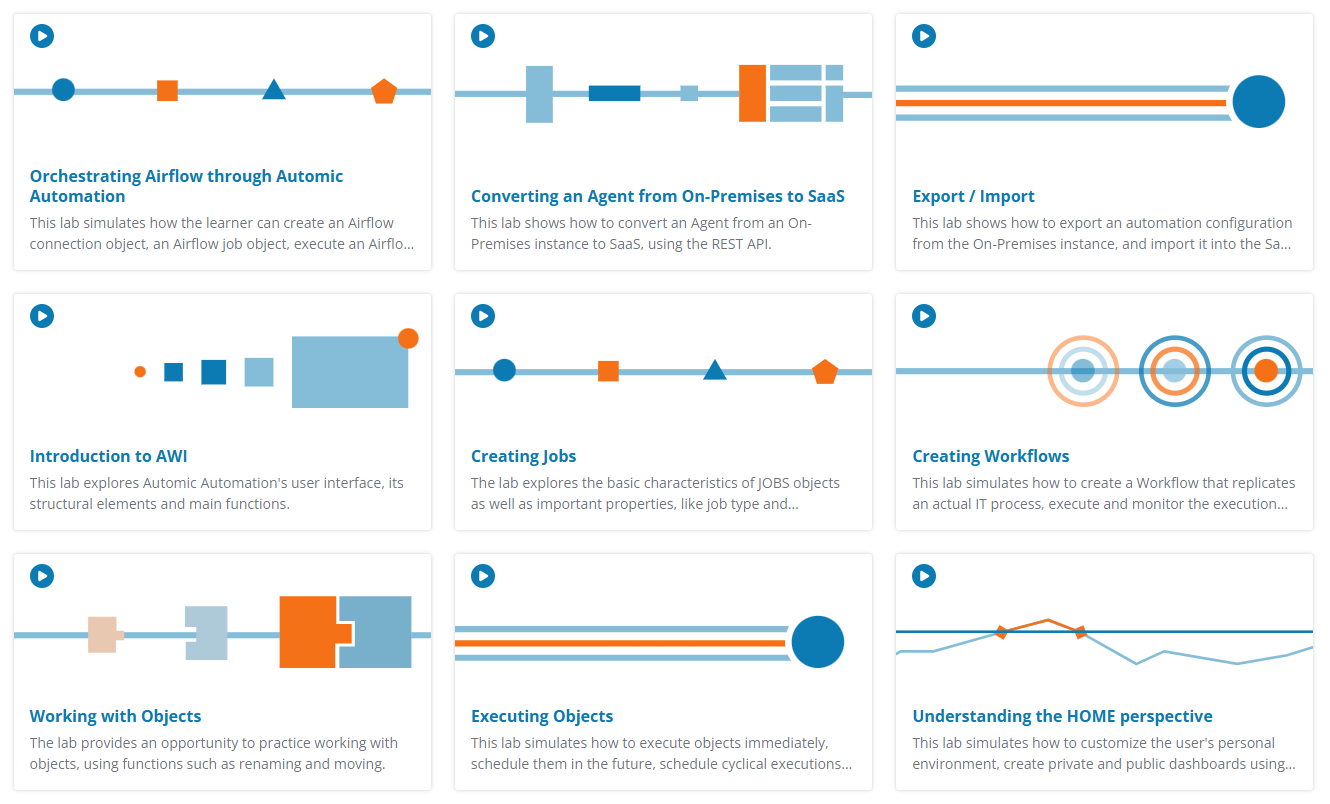
    Broadcom’s Simulation Labs offer an interactive, hands-on learning environment designed to complement and enhance course materials. They provide realistic scenarios and practical exercises, allowing you to reinforce your learning experience and apply your skills in executing, scheduling, and managing automation tasks in a controlled simulation setting, without impacting live systems.