
As a product manager, I frequently get the opportunity to talk to customers about Rally. Sometimes I’ll speak with someone who’s skilled with the platform. Other times, I’ll chat with someone who’s just getting started with the solution. Either way, we pretty much always uncover some capabilities that the user didn’t know about before.
Even those who’ve been using the platform for a long time may be accustomed to working with the solution in a specific way, and may not have tried some different capabilities. In addition, since we’re constantly adding new features to Rally, some users may not know about some of the latest capabilities.
Whether you’re a Rally veteran or just getting started, here are three capabilities that I think you owe it to yourself to check out.
Area 1: Team Board
Rally’s Team Board enables you to work in a flow-based manner. Teams can visualize their workflow and they can use these views to complete their day-to-day activities. They can also customize how they wish to work via custom workflow states, work-in-progress (WIP) limits, and exit agreements. They can also roll these metrics up to the program and portfolio levels.
The Team Board has been around for a long time, so you may be wondering why this is the first area I’m featuring. Here are two reasons:
1. Employ time-based elements in flow-based work, and vice versa
We’ve gotten a lot of feedback from our users in this area. Many users have asked us to bring features from the Iteration Status page to the Team Board. These users would like time-based elements to use in their flow-based work and vice versa. As a result, we’ve added the Timebox drop-down to the left of the Saved Views field.
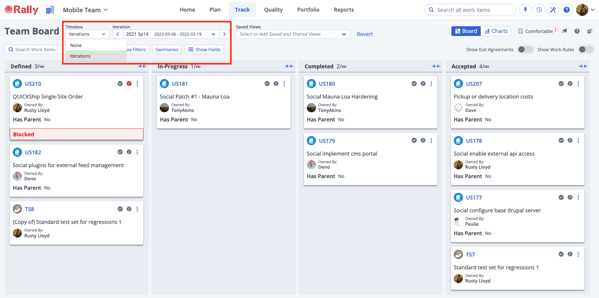
This will make it easy for teams to work in a variety of ways, from Kanban to Scrumban, or something in between.
In the near future, you’ll see the addition of Releases and Milestones to the Timebox drop-down as well. This will give you more versatility in bringing in the time-specific information you want to combine with your flow-based work.
2. Flow metrics and scatterplot/histogram pages
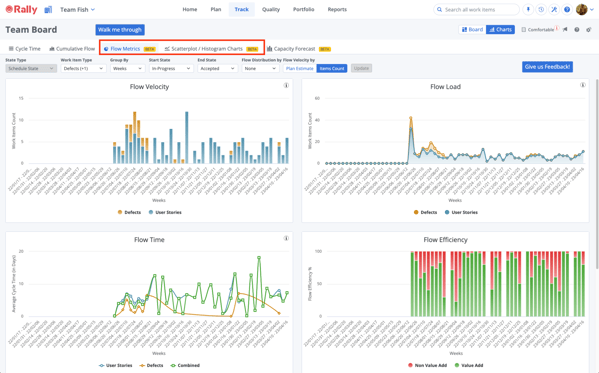
To help teams work smarter and more efficiently, we’ve added a variety of metrics to the Team Board. You are likely used to the Cycle Time and Smart Cumulative Flow reports. What you may not have seen are the new Flow Metrics and Scatterplot/Histogram pages. Clicking on the Charts tab will show you this new set of analytics updates designed to help your team improve on their work delivery.
Area 2: Timeline
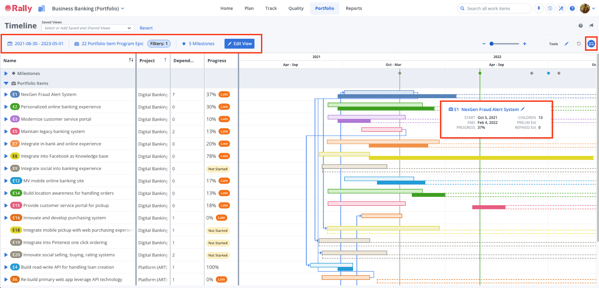
Rally’s Timeline page is invaluable for facilitators of teams and teams of teams. The page enables users to visually display portfolio items over a time-based view, organized by project.
You can use the Timeline page to manage priorities and to help determine where work fits into your overall schedule, based on the information you currently have. Think of this page as a work execution roadmap. The page shows plan data across multiple teams and helps you to visualize how the work relates across those teams and their schedules.
Portfolio managers, product managers, and other executives can use the Timeline page to quickly view portfolio items in relation to other portfolio items, milestones, and their start and end dates. As the team provides additional input and further defines project details, this page reflects those refinements.
The Timeline page provides all of these capabilities in a single view:
- Filter work types and date ranges
- View and edit the planned dates of Portfolio Items within dates you specify, and review milestones
- Zoom and scroll the timeline to review specific data
- See dependencies between portfolio Items
Area 3: Work Rules
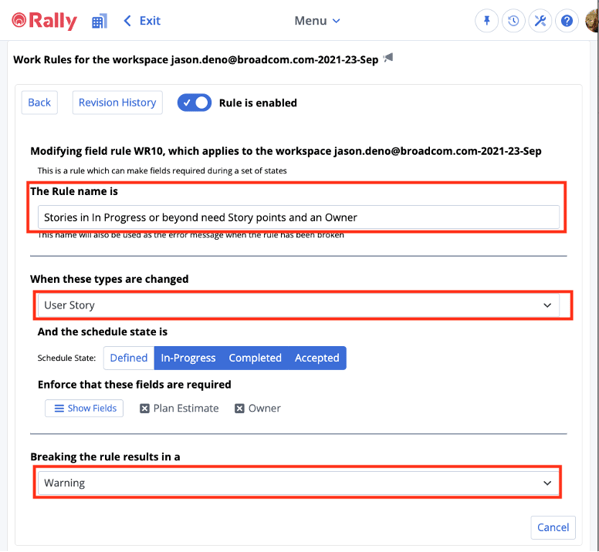
Sometimes, you need to gently guide your users to make sure that they are working in the ways that you want them to. Rally’s Work Rules capability enables you to create field-level rules that help govern your team's day-to-day work activities. These rules can be required or read only.
You can create Work Rules for both Work Items and Portfolio Items. Work Rules for Work Items and Portfolio Items are triggered as the work items transition to the configured Schedule States or configured Portfolio Item states that you specify.
For Work Items, Work Rules can apply to Stories, Defects, Defect Suites, and Test Cases. You can apply Work Rules to any Portfolio Items defined in your Rally subscription.
Work Rules can be applied at the Workspace level or Project level. Work Rules can also cascade from parent projects to child projects. Note: You can only edit a cascading work rule from the Workspace or Project in which the rule was created.
There are two types of Work Rules:
- Errors: Restricts the state movement of a Work or Portfolio item and displays a warning if a work rule is violated. It also provides information on the violation.
- Warnings: Displays a warning if a work rule is violated for a Work or Portfolio item and provides information on the violation.
You can view Work Rules that are applied to your Work Items by selecting the “Show Work Rules” button from both the Team Board and the Portfolio Kanban pages.
Embracing the New
As customers continue on their Agile software development journey, their needs can change frequently. We want to make sure that we are in step with those changes. We are always listening to our customers and assessing ways we can inspect and adapt the Rally platform to improve our customers’ overall experience.
This post offers a very abbreviated view of these three features in Rally—they are much more robust than we have space for in this blog. To learn more on these topics, check out our Product Help pages. To get more information about new and improved capabilities in Rally, be sure to see our Release Notes.

Aaron Rusty Lloyd
Aaron "Rusty" Lloyd is a technology evangelist with a demonstrated record of success in sales, consulting, software development and technical support projects that transform business operations. He delivers leading-edge products and technology systems that drive business performance and efficiency.
Other resources you might be interested in

AAI v26.0 - Linux Standalone Upgrade
Learn how to upgrade a standalone AAI installation on Linux from version 24.4.x to 26.0. Find out about updated configuration and log structures.
Automic Automation: Transition to SAP RISE with Confidence
Automic Automation safeguards Clean Core architecture, mitigates SAP RISE migration risks, and unifies enterprise scheduling from mainframe to cloud.
AutoSys Workload Automation: Transition to SAP RISE with Confidence
AutoSys safeguards Clean Core architecture, mitigates SAP RISE migration risks, and unifies enterprise workload scheduling from mainframe to cloud systems.
AppNeta: Manage Alarm Rules
Learn how to create and manage alarm rules in AppNeta. Detect, isolate, and present user-impacting issues to network operations center teams.
Rally Office Hours: October 8, 2026
Find out about a new “my notifications” widget and an enhanced planned/unplanned widget. Hear about diverging axis views and upcoming cycle time widgets.

Going Off-Road: How We Bulletproofed Automic's Zero Downtime Upgrades
To ensure absolute reliability at SaaS scale, Automic Automation recently evolved its ZDU strategy.
Rally Office Hours: October 1, 2026
Explore Rally updates, including end-to-end markdown support, a new defect trend widget, an update dependency widget, and custom view migration status.
Clarity: Design Visual Layouts Using Report Designer
This course teaches you how to create new reports with the Clarity Report Designer.
Rally Office Hours: September 24, 2026
Find out about a new milestone cumulative flow diagram widget and custom view widget capacity. Get tips for handling project name changes in middleware.