
Global teams must track productivity and product quality — while having visibility into dependencies — to deliver cohesive value to customers faster and with fewer problems.
This cohesive value comes from adopting a flexible, interactive approach through agile product management and software development, supported by an enterprise agile management solution.
Mainframes are now supporting the most progressive and popular application types like web and mobile. The need for enhanced digital experiences delivered to customers via web and mobile apps is driving increased interaction with application data housed on the mainframe. Increasing mainframe speed and delivery is critical.
One study by McKinsey shows adopting agile practices can lead to a 30% to 50% increase in operational performance as measured by speed, target achievement, and predictability. The same study shows a 30% increase in overall financial performance.
Today, there’s no denying the benefits of agile.
So how can mainframe developers leverage the benefits of agile while avoiding risk and disruption to their daily work? Before answering that, let’s level-set on challenges.
Today, some mainframe development teams track their work using Agile methodology; some developers don’t, however, because they don’t have access to an Agile solution, and they thus lack visibility into stories, dependencies, teams, and projects that are connected to their tasks.
These development teams are disconnected from global development efforts and siloed during the planning process. Silos impede productivity, call into question data integrity, and give rise to confusion. Inconsistent dev times and time-consuming responses to questions around progress and reporting updates all factor into a very slow, and often frustrating, delivery.
Connecting mainframe developers into the agile world is a low-risk approach for speed to market.
In an article published by SD Times, “Mainframe for DevOps puts an end to silos,” one industry expert said:
“The lower risk approach is to say what are the things that are stopping me from moving quickly. By bringing mainframe development into a more Agile framework allows you to actually accelerate the delivery of change from cutting the code through to actually deploying it to production.”
What does “agile” mean?
Don’t let the word “agile” complicate things. At its core, agile is about global teams tracking productivity and product quality while having visibility into dependencies, so together they deliver cohesive value to their customers faster and with fewer problems.
Start with leveraging what you have: Software Configuration Management
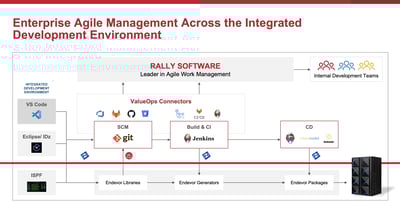
Mainframe developers use Broadcom Endevor as their software configuration management solution. Endevor provides a standardized, reliable, and automated approach to securing and managing your software assets. Designed to automate the development process, Endevor governs software change from the very first line of modified code through deployment with change tracking. Endevor also provides users additional flexibility in their choice of interface and tight coupling with their DevOps toolset.
The additional flexibility Endevor offers provides a pathway to enterprise agile management. With out-of-the-box integrations to CI/CD and pipeline management tools along with plugins to enterprise GIT repositories, teams can adopt the same modern stacks used for distributed development while continuing to leverage the build and lifecycle automation offered by Endevor.
With those integrations and plugins, mainframe developers have a portal into popular agile work management solutions.
Introducing Rally Software: give the business predictability and adaptability
Rally Software is the market-leading enterprise agile management solution. For millions of global teams, Rally is the ecosystem for their interconnected strategy. Teams run with clear goals and opportunities to adjust when they see strategic themes, initiatives, features, stories, and tasks all connected.
Rally gives the user visual cues to take action based on the related data. Mainframe developers have seamless traceability between the changes being made in version control and agile work item artifacts, including user stories and defects. This enables developers to easily see what changes were made for any given work item, significantly reducing mean time to resolution (MTTR) when debugging problems.
Can you imagine the positive impact to your operational performance when both product and business teams have top-down visibility from Business to Development? How much more will your day-to-day operations improve when you can track dependencies and easily find associated Epics and Features that are connected directly to your strategy?
Need reporting and analytics to show what you’re doing, why you did it, how you did it, and when it’s going to be delivered? Rally’s got that covered too.
Without disrupting your day-to-day activities and by consistently mitigating risks, Rally gives the business predictability and full traceability across your end-to-end lifecycle. Through its ValueOps Connectors, Rally integrates seamlessly with your ecosystem by connecting to the tools you already have and use today, no data scientist required.
Mainframe developers will be connected to global development efforts and included in the planning process. There will be predictability in development times with transparent reporting. Product delivery will never be the same again.
What’s Your Next Move?
- Lead your company in financial 30% performance gains.
- Lead your company to 50% operational efficiency gains.
- Lead your company to 30% employee engagement improvements.
Your customers should love you, and Rally Software customers love Rally.
To learn more about Enterprise Agility and Rally Software, go to broadcom.com/rally.
In addition, you can also review the solution brief, "Rally Software and Endevor Bring Agility to Mainframe Development" at the top of the page and watch this technical demo:

Michelle Kerby
Michelle brings more than 20 years of experience in marketing and sales leadership for Fortune 500 companies. She is passionate about solving customer challenges and creating loyal evangelists. Michelle is based in Silicon Valley.
Other resources you might be interested in

AAI - Creating and Publishing AI-powered Data Insights
Learn how to create AI-powered data insights using natural language prompts, refine the generated results, and publish useful insights.
AAI - Configuring the Cost Model for Chargeback Reporting
Learn how to configure the Cost Model in AAI by defining cost centers, associating jobs with those cost centers, and entering annual cost factors.
Clarity: Strategic Workforce Planning with the Staffing Workspace
This course blends strategic portfolio management (SPM) concepts with Clarity Staffing. See how to use the product and make better business decisions.
Rally Office Hours: August 20, 2026
This Rally Office Hours session reveals the general availability of a Kanban board extension to the custom board widget. Get expert tips for custom views.
ValueOps ConnectALL 101
This is an introductory course for new ConnectALL administrators and implementation teams.
AAI: Monitoring Global Shift Operations with Jobstream Runs Views
Focuses on live operational triage, teaching operators to track real-time executions, identify "Red-Zone" failures, and drill down to resolve bottlenecks.
AAI: Triaging Incidents via the Gantt View
See how to use the Gantt Command Center to isolate failures and restore pipelines. Trace dependency paths, evaluate delays, and inspect job properties.
AAI: Tracking Trends & Runtimes with Jobstream Run Details
Learn how to analyze multi-week historical performance using Actual, Relative to SLA, and SLA Graph views. See how to spot and prove performance issues.
Rally Office Hours: August 13, 2026
This Rally Office Hours session covers upcoming product deprecations, custom view migrations, high-level reporting solutions, and workspace field updates.