
|
Key Takeaways
|
|
Emergence, growth of SASE
For today’s enterprises, ensuring optimized network connectivity and robust network security represent key imperatives. Given that, it makes sense that there’s rapidly growing use of solutions like secure access service edge (SASE). In fact, the SASE market is expected to grow to $5.9 billion by 2028.
SASE delivers converged network and security capabilities. SASE is a cloud-based offering that is primarily delivered on an as-a-service basis. SASE solutions typically feature a range of integrated security capabilities, such as secure web gateways, cloud access security brokers, firewall as-a-service, and zero-trust network access.
In addition, software-defined wide area networks (SD-WANs) represent a core component. It’s now more common for teams to purchase SD-WAN as part of a SASE offering than in a standalone fashion. According to Gartner, 60% of SD-WAN purchases are part of a SASE offering from a single vendor.
In SASE environments, SD-WAN delivers several key capabilities:
- Tunnel bonding. With SD-WAN, teams can combine MPLS with various networks, including internet, cellular, and satellite connections.
- Network optimization. SD-WAN enables the dynamic selection of optimized paths for network delivery, ensuring all packets are sent with minimal latency. These solutions determine optimized network paths based on network and app usage.
- Multi-cloud networking. SD-WAN solutions are run in the cloud and they offer support for services running across multiple cloud environments.
- Zero-trust segmentation support. SD-WAN offers strong capabilities for supporting the segmentation that is key to successful zero-trust approaches.
The criticality of SD-WAN availability
Given the critical role these services play in SASE implementations, if SD-WAN systems encounter issues, it can have significant ramifications for users and organizations. Ultimately, the more resilient SD-WAN technologies are, the more benefits SASE can provide to network operations teams and customers.
For network operations teams, SD-WAN solutions offer monitoring capabilities that provide edge-to-edge coverage and visibility into tunnels. However, these tools lack visibility into all the other elements that can affect the user experience, including endpoints, ISP networks on the user side, and within the infrastructure of internal data centers and externally managed ISP and SaaS environments.
These visibility gaps can expose organizations to outages and leave network operations teams reacting to issues rather than managing service levels proactively. As organizations grow more reliant on SASE and SD-WAN, the demand for establishing end-to-end observability is becoming increasingly critical.
The solution
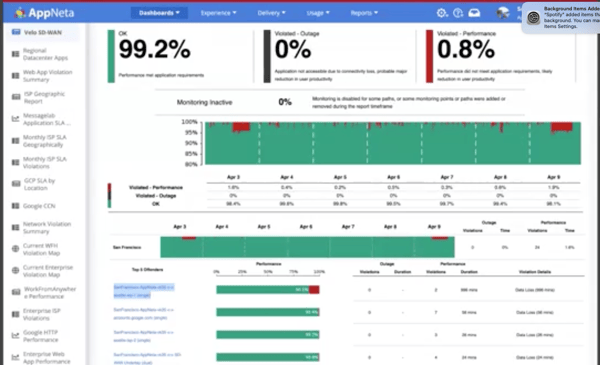
AppNeta by Broadcom extends network operations teams’ visibility beyond the SD-WAN edge, and delivers true, end-to-end observability across modern environments. With AppNeta, teams can actively monitor network delivery experience over paths to cloud, SaaS, and other external sites. AppNeta enables teams to fully understand how performance is affected by common issues like application outages, route changes, connectivity drops, and ISP peering changes.
AppNeta delivers these essential capabilities:
- Underlay route visibility. With AppNeta, teams can gain an understanding of what routes are being used, and how routes are performing. The solution helps teams validate how the underlay is performing in delivering the overlay tunnel. The solution delivers unified coverage of multi-vendor networks, including high-latency satellite and cellular networks. AppNeta can provide visibility into which vendor is providing the connection, how it is performing, and how to measure performance against SLAs.
- Root cause analysis. AppNeta helps identify which domains errors are arising in, whether in home offices, enterprise offices, ISP or SaaS provider networks, or any other location. With the solution, teams can spot where problems are emerging and quickly drill down to identify the source of degradation. By enabling fast identification of the error domain across these environments, AppNeta speeds mean time to insight, mean time to innocence (MTTI), and, when issues arise in internally managed environments, mean time to resolution (MTTR).
- Application context. AppNeta delivers unparalleled capabilities for tracking the end-user experience across network and application environments. The solution delivers detailed insights to internal network operations teams, as well as whoever is responsible for the application, whether internal development teams or service providers. When application issues arise, network operations teams can prove that it’s not a network issue and offer visibility into where in the application environment an issue may be occurring. AppNeta delivers hop-by-hop visibility, tracking network performance time, application performance time, browser rendering time, and more.
Conclusion
To maximize the value of SASE investments, it is critical to gain end-to-end observability of the SD-WAN environment and beyond. With AppNeta, teams can get this comprehensive visibility, enabling faster MTTI and MTTR.
To learn more, be sure to review the Small Bytes webcast, Eliminate SD-WAN blind spots to drive successful SASE initiatives. Our Small Bytes series offers practical examples on getting the most from Broadcom solution investments. Visit our Small Bytes page to see a complete list of upcoming and on-demand presentations in the series.

Seth Differ
Seth Differ is a senior manager leading the NetOps Solutions Architects team, specializing in network performance monitoring. He translates complex technologies into business value, helping organizations optimize performance and visibility. He focuses on delivering innovative solutions that enhance network efficiency...
Other resources you might be interested in
Automic Automation: Transition to SAP RISE with Confidence
Automic Automation safeguards Clean Core architecture, mitigates SAP RISE migration risks, and unifies enterprise scheduling from mainframe to cloud.
AutoSys Workload Automation: Transition to SAP RISE with Confidence
AutoSys safeguards Clean Core architecture, mitigates SAP RISE migration risks, and unifies enterprise workload scheduling from mainframe to cloud systems.

AppNeta: Manage Alarm Rules
Learn how to create and manage alarm rules in AppNeta. Detect, isolate, and present user-impacting issues to network operations center teams.
Rally Office Hours: October 8, 2026
Find out about a new “my notifications” widget and an enhanced planned/unplanned widget. Hear about diverging axis views and upcoming cycle time widgets.

Going Off-Road: How We Bulletproofed Automic's Zero Downtime Upgrades
To ensure absolute reliability at SaaS scale, Automic Automation recently evolved its ZDU strategy.
Rally Office Hours: October 1, 2026
Explore Rally updates, including end-to-end markdown support, a new defect trend widget, an update dependency widget, and custom view migration status.
Clarity: Design Visual Layouts Using Report Designer
This course teaches you how to create new reports with the Clarity Report Designer.
Rally Office Hours: September 24, 2026
Find out about a new milestone cumulative flow diagram widget and custom view widget capacity. Get tips for handling project name changes in middleware.
Rally Office Hours: September 17, 2026
Explore Rally's new delivery confidence feature for portfolio items, hear custom view migration updates, and get expert answers to Q&A.