
With the latest release of our network monitoring and digital experience monitoring software, we are proud to introduce an industry-first Experience-Driven NetOps solution, taking network visibility to the new enterprise network, expanding beyond the network edge to ISP and cloud providers. The DX NetOps 22.2 release will enable teams to operationalize the new enterprise network, focus on user experience, and avoid chasing utilization spikes.
But what is the new enterprise network? Years ago, most internet traffic was just web browsing. Our email, payroll, accounting, file storage was all done in that cold, raised floor room we used to call a server room. Branch offices were connected with dedicated circuits back to the main corporate building for application and internet connectivity as well.
Over the years, data centers have moved out of the corporate headquarters to their own facilities, extending the enterprise network. And recently, we are seeing more of those same applications that used to live in our data centers moving to cloud and SaaS providers, further extending the network along with more SD-WAN adoption to securely and cost effectively get to those applications.
The pandemic has accelerated the speed of change into another dimension, with more people working remotely and many analysts agreeing that a majority of business activities will permanently shift to the cloud and remote workers.
As a result, network traffic today spends much more time on the internet than in our own data centers. The internet has become the new enterprise network.
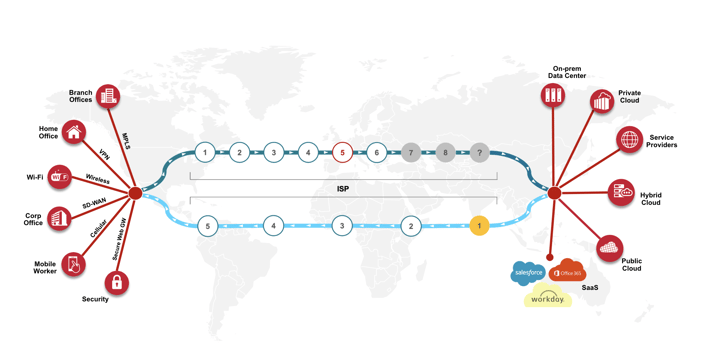
Figure 1: The internet is now the new enterprise network where a majority of the user experience resides.
This latest release of our award-winning solution will transform Network Operations Center (NOC) triage and response times by bringing user experience to the forefront of Network Operations across traditional and SDx networks, on-premise or in the cloud, and across the WAN. It extends your visibility across the internet for a complete hop-by-hop picture of modern network delivery for the SaaS-based user experience, work from anywhere user experience, and hybrid-cloud user experience, along with active testing of modern network delivery before, during, and after deployments.
Most importantly, we are routing these user experience metrics through the NetOps standard operating procedures and workflows you have come to depend on. Backed by alarms, events, topology, performance, faults, flows, logs, configurations, and now user experience metrics from AppNeta, you will still be able to easily triage, quickly find root causes, escalate to engineers or architects, open trouble tickets, or isolate and resolve network delivery issues impacting user experiences yourself.
This is what it means to operationalize the new enterprise network, and in order to be successful at that, Broadcom Software is delivering industry-first capabilities in the latest release of DX NetOps 22.2 in the following areas:
- Innovate at Scale with continuous, high-scale, end-to-end network delivery monitoring and validation of user experiences over modern network architectures like SD-WAN, SDDC, and enterprise Wifi.
- Optimize Operations by prioritizing network operations triage based on experience metrics for enhanced isolation of any network performance impacts on the user experience.
- Protect the Digital Experience with high-scale visibility and fault tolerant data collection beyond the network edge and into ISP and cloud providers.
With the latest release of our DX NetOps 22.2 network monitoring software, combined with AppNeta's end-to-end digital experience visibility, you can count on having access to a single source of truth to easily triage user experience network delivery issues for any technology, running on any network, anywhere in the world.
Register for our upcoming customer webcast to see all the features and capabilities outlined here.

Jeremy Rossbach
As the Chief Technical Evangelist for NetOps by Broadcom, Jeremy is passionate about meeting with customers to identify their IT operational challenges and produce solutions that fit their business and network transformation goals. Prior to joining Broadcom, he spent over 15+ years working in IT, across both public...
Other resources you might be interested in

AAI - Creating and Publishing AI-powered Data Insights
Learn how to create AI-powered data insights using natural language prompts, refine the generated results, and publish useful insights.
AAI - Configuring the Cost Model for Chargeback Reporting
Learn how to configure the Cost Model in AAI by defining cost centers, associating jobs with those cost centers, and entering annual cost factors.
Clarity: Strategic Workforce Planning with the Staffing Workspace
This course blends strategic portfolio management (SPM) concepts with Clarity Staffing. See how to use the product and make better business decisions.
Rally Office Hours: August 20, 2026
This Rally Office Hours session reveals the general availability of a Kanban board extension to the custom board widget. Get expert tips for custom views.
ValueOps ConnectALL 101
This is an introductory course for new ConnectALL administrators and implementation teams.
AAI: Monitoring Global Shift Operations with Jobstream Runs Views
Focuses on live operational triage, teaching operators to track real-time executions, identify "Red-Zone" failures, and drill down to resolve bottlenecks.
AAI: Triaging Incidents via the Gantt View
See how to use the Gantt Command Center to isolate failures and restore pipelines. Trace dependency paths, evaluate delays, and inspect job properties.
AAI: Tracking Trends & Runtimes with Jobstream Run Details
Learn how to analyze multi-week historical performance using Actual, Relative to SLA, and SLA Graph views. See how to spot and prove performance issues.
Rally Office Hours: August 13, 2026
This Rally Office Hours session covers upcoming product deprecations, custom view migrations, high-level reporting solutions, and workspace field updates.